
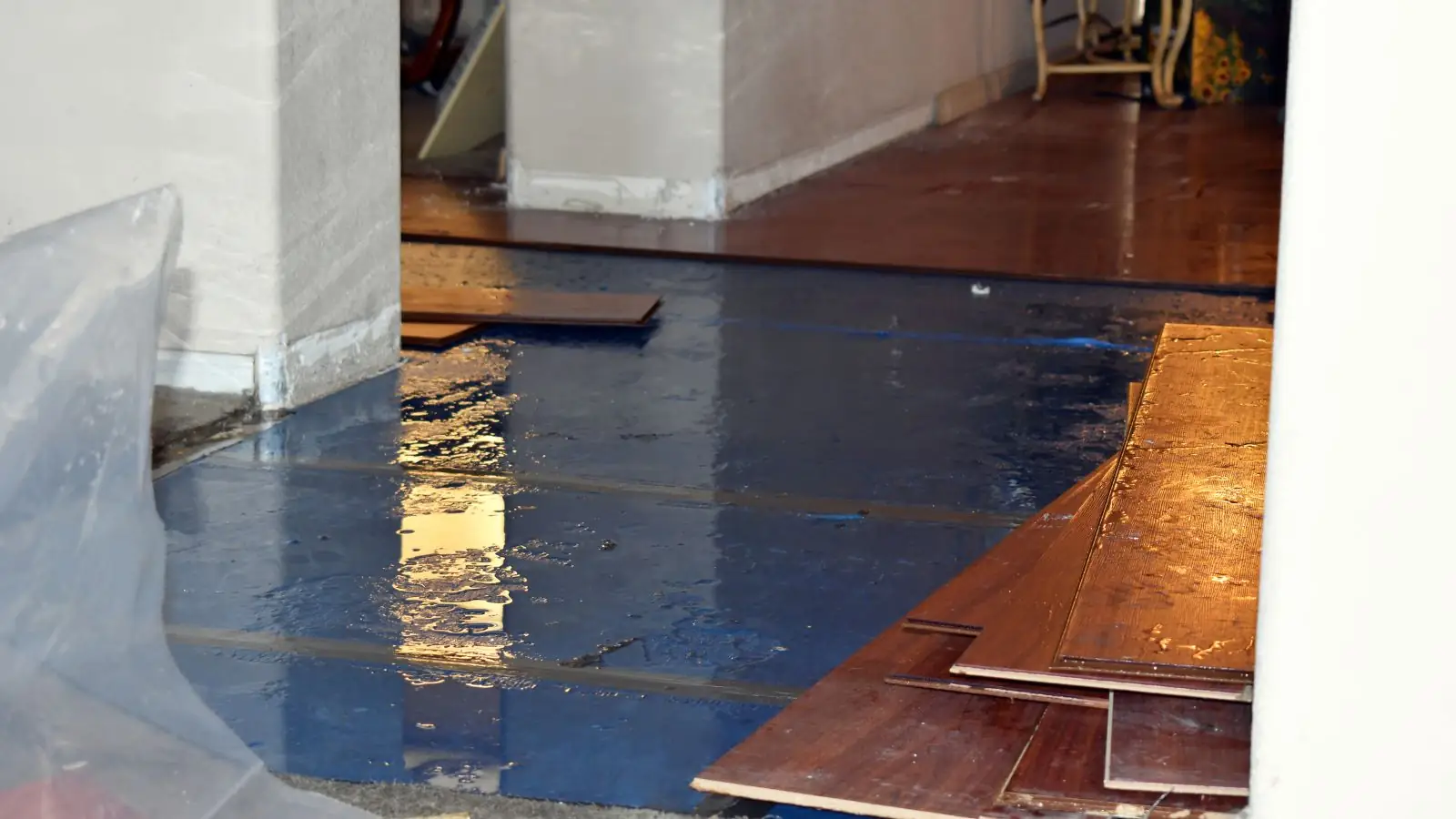
Water damaged hardwood floors can often be saved when the water is stopped, the boards are dried slowly and the repair waits until readings are normal. They cannot be saved when the floor stays wet for days, when the water was contaminated or when the subfloor has started to fail. This guide explains how to tell which situation you are in and what the fix looks like.
First hours: what to do before anyone arrives
- Shut off the water source, or the main valve if you cannot find it.
- Soak up standing water with towels, a mop or a wet vacuum.
- Lift rugs, mats and furniture legs off the wood and slide foil or plastic under anything you cannot move.
- Open doors and windows for airflow when the weather allows, and run fans along the floor.
- Photograph the room, the source and any damage before you move more items.
- Do not use heat guns, hair dryers or space heaters to speed drying.
Quick action matters because wood takes on water through its edges and its underside as well as its surface. EPA guidance on damp buildings recommends drying within 24 to 48 hours to limit mold growth. A floor that has been wet for longer than that needs a moisture reading before anything else.
Is the floor worth saving
| Condition | Usually | Notes |
|---|---|---|
| Clean water, caught within a day, boards flat | Dry and refinish | Best-case outcome. |
| Light cupping, readings falling | Dry slowly, wait, then sand | Cupping often eases as boards dry. |
| Boards lifting or crowned across a large area | Partial or full replacement | Subfloor needs a check. |
| Sewage or floodwater | Replace affected boards | Porous wood holds contamination. |
| Black staining or a musty smell | Open up and inspect | Moisture has likely been present for some time. |
| Engineered wood with peeling layers | Usually replace | The glue layers have failed. |
The category of water matters as much as the time. Clean supply water gives you the most options. Water that came from a drain, toilet overflow or outdoor flooding carries bacteria, and porous wood that has absorbed it generally has to be removed. Our page on flood damage restoration explains how contaminated water is handled.
How professionals dry a hardwood floor
A crew starts with moisture readings across the floor, in the subfloor and at the baseboards, and marks the wet zone. Surface water is extracted, then drying mats pull moisture upward out of the boards while air movers and dehumidifiers manage the room. Some floors are dried through small ventilation holes at the edge when the board faces are too tight to dry from above.
Drying takes days, not hours, and it is monitored. The crew returns to recheck readings, moves equipment and stops when the boards match a dry reference. Our water mitigation service describes the equipment and daily checks in more detail.
Floor wet right now?
Call and we explain what to do in the first hours.
Sanding and refinishing after drying
Once the floor is dry and has been allowed to settle, mild cupping or crowning is often fixed by sanding the surface flat. Waiting matters, because boards can keep moving for a while after they read dry. Refinishing too early can lock in a floor that then shrinks and opens gaps.
The finish is the last step. A sanded floor is stained to match the rest of the room, then sealed with several coats. If only part of the floor was damaged, the repair is blended into the surrounding boards, and the finish is carried to a natural break, such as a doorway, so the edge does not show.
Replacing boards that cannot be saved
Replacement starts with cutting out the damaged boards along their length and weaving in new ones, or replacing a full section. New boards are rarely an exact match for old ones because aged wood changes color. A crew will often test stains on a sample, or recommend refinishing a larger area, so the new boards blend.
Where the subfloor was wet, it must be dry and sound before new boards go down. Putting new flooring over a damp subfloor is how floors cup a second time. The sequence of drying first and rebuilding second is the same one used for water damage repair on any building material.
Mistakes that turn a recoverable floor into a lost one
- Leaving a rug or mat on a wet floor, which traps water against the finish.
- Sealing the floor with a wax or coating before it is dry.
- Waiting for the stain to dry on its own instead of getting a reading.
- Using heat to dry the boards quickly.
- Sanding while the floor is still above its normal moisture content.
- Covering a damp floor with new flooring, vinyl or a rug.
Questions to ask a contractor
Ask how the moisture will be measured, how many days the drying will take and who will return to take the readings. Ask whether the plan is to dry and refinish or to replace, and what the readings will need to show before the next step begins. A clear answer to those three questions separates a careful crew from one that simply starts sanding.
You can read how we price jobs without quoting figures in advance. Scope, floor area, wood type and the amount of finish work all change the cost, and we explain the factors before work starts.
Caring for the floor in the weeks after the repair
A repaired floor settles for a while. Keep humidity steady, avoid heavy rugs for the first weeks and use felt pads under furniture. If you see new gaps or lifting, take a photograph and a moisture reading early, since a second leak or a damp subfloor is easier to catch before the finish fails.
The Santa Barbara service page describes how a job in the neighboring city works, and the service areas page lists the other towns near Goleta where we can help.
Goleta local note: older homes and finish matching
Many Goleta homes carry wood floors with decades of finish. A sample taken from a closet or under a vent opening helps the refinisher match stain and sheen, and photographs of the floor before the damage are useful for the same reason.
If you rent, tell the landlord in writing about the damage before any boards are lifted. In a condominium, ask the association which unit owns the subfloor, since that affects who arranges the repair.
Hardwood floor water damage questions
Can hardwood floors be saved after a leak in Goleta?
Often, if the water was clean, the leak was stopped quickly and drying started within a day or two. A moisture reading shows whether the boards and subfloor can be dried in place.
How long should I wait before sanding a wet floor?
Until moisture readings match a dry board from the same floor and the boards have stopped moving. That can take days or weeks depending on the damage.
Why did my boards cup after the leak was fixed?
The bottom of each board dried more slowly than the top, or moisture is still coming up from below. Cupping can ease as the floor equalizes.
Should I replace the whole floor or only the damaged area?
That depends on the extent, the wood type and whether a patch can be blended. Matching color across a large open floor is often the deciding factor.
Questions about your own situation?
Call the 24/7 line and describe what you see. Call and we explain what to do in the first hours.