
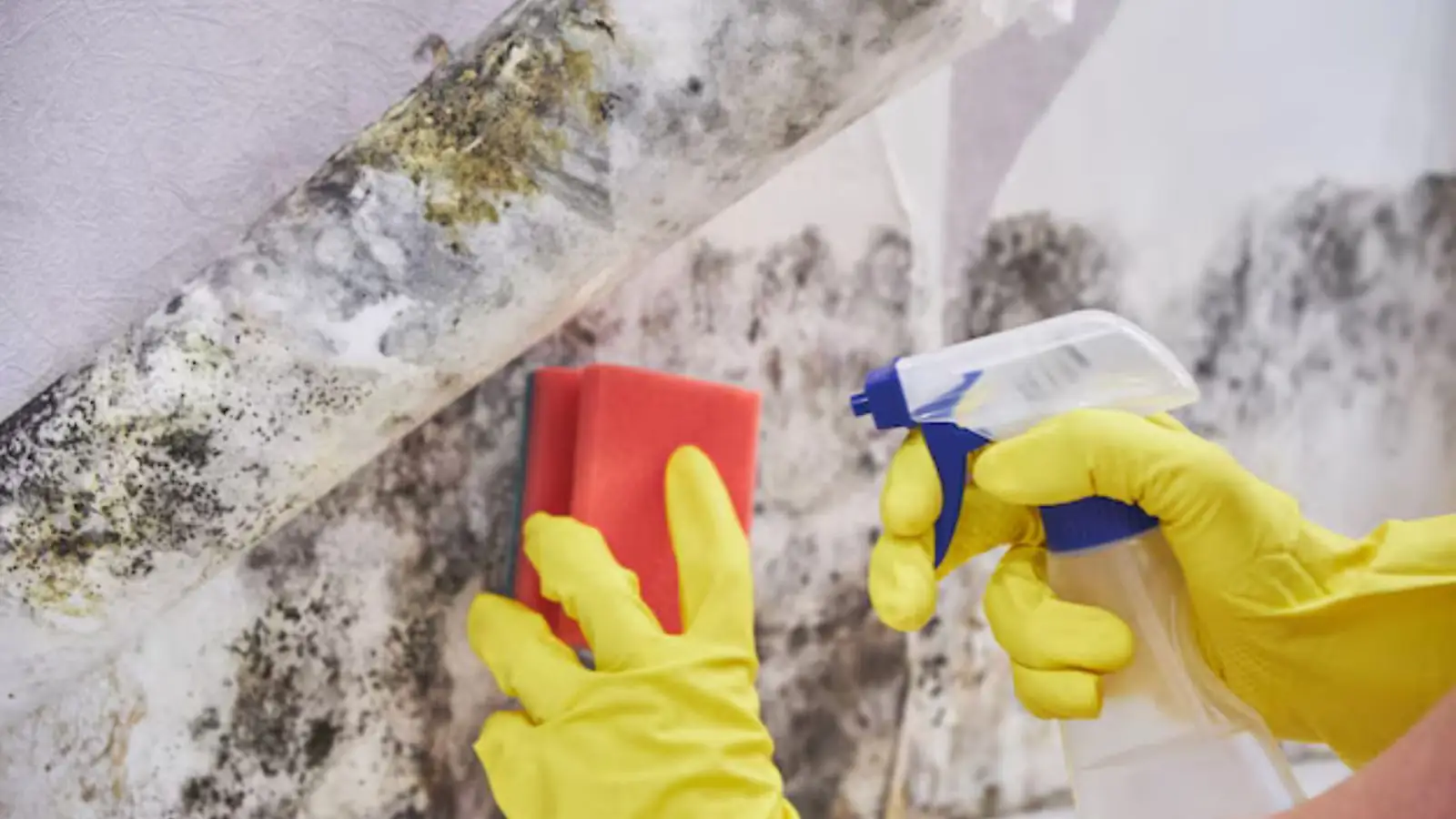
Getting rid of black mold for good means removing the growth and removing the moisture that fed it. Scrubbing a stain without fixing the leak behind it only buys a few weeks. This guide explains what a homeowner can safely clean, what should be left to a crew and how to keep the problem from returning.
Step one: find the moisture
Before anything is cleaned, find out why the area is wet. Check for leaking pipes, roof or window leaks, condensation on cold surfaces, a clogged dryer vent, a wet crawl space or a bathroom without a working fan. A moisture meter helps, and a thermal camera finds hidden wet areas.
If the growth is a result of a flood, a pipe burst or a roof leak, drying comes first. Our water mitigation service describes how wet materials are dried to normal readings, and a mold plan should follow that, not replace it.
Step two: decide how big the problem is
| Situation | Usual response | Who does it |
|---|---|---|
| A few spots on tile or grout | Scrub with detergent and dry | Homeowner. |
| Patch under 10 square feet on a hard surface | Clean with protection and fix the cause | Homeowner, carefully. |
| Patch on drywall that is soft or stained through | Remove the board | Trained crew or contractor. |
| Growth over 10 square feet | Containment and removal | Mold remediation crew. |
| Growth after sewage or flood water | Remove porous materials | Restoration crew. |
| Musty smell with no visible source | Inspect cavities and moisture | Restoration crew. |
Size is a guide, not a rule. A small patch that keeps coming back deserves a closer look, and a large patch on tile can be simpler than a small one in a wall.
Step three: protect yourself and the house
Wear non-porous gloves, goggles and a mask rated for fine particles. Close doors, turn off the air handler and seal the work area with plastic if the patch is large enough to produce dust. Do not use a household fan that blows spores through the home.
Never mix cleaning products. Combining bleach and ammonia, for example, makes a gas that is dangerous to breathe. Use one product at a time and ventilate the room.
Growth keeps coming back?
Call and we explain how to find the moisture behind it.
Step four: cleaning hard surfaces
- Mist the surface lightly to keep dust down.
- Scrub with detergent and water, working from clean to dirty areas.
- Wipe with clean water and dry with towels.
- Place used towels in a sealed bag before leaving the room.
- Run a dehumidifier until the surface and the air feel dry.
EPA guidance does not recommend routine use of biocides to treat mold, and says physical removal and drying are what matter. Bleach is not required for hard surface cleaning and does not help on porous materials because it does not reach the roots of the growth.
Step five: porous materials
Drywall, ceiling tile, carpet and insulation that carry growth are normally removed, not cleaned. Mold grows into these materials, and wiping the surface leaves the rest behind. Remove the section back to clean, dry material, bag it before moving it and dispose of it with household trash unless local rules say otherwise.
If the growth is in a wall cavity, the safe route is a crew that can open the wall under containment. Our mold remediation page explains the containment, negative air and cleaning steps they use.
Step six: verify the area is dry and stays dry
After cleaning, take moisture readings or watch for signs of dampness for several weeks. Return of the growth means moisture is still present. Improve ventilation, repair leaks and keep humidity down, since a dry surface does not support growth.
If the area stays clean and dry, repair and repaint with a primer that suits the room. Only then is the project complete.
What does not work
- Painting over mold without removing it or fixing the moisture.
- Using a fan to dry a moldy patch and blowing spores through the home.
- Spraying a product and walking away without scrubbing or drying.
- Cutting out only the visible spot when the wall behind is also wet.
- Treating a recurring patch as a cosmetic problem.
Where growth hides
Check behind furniture pushed against exterior walls, under sinks, inside cabinets, around window frames, behind washing machines and above ceiling tiles. A flashlight held at a low angle shows fuzzy texture that is hard to see in normal light. Smell is a clue too, and a musty closet usually has a damp wall behind it.
Cleaning supplies and gear
- Non-porous gloves and goggles without vent holes.
- A mask rated for fine particles.
- A stiff brush and a bucket of detergent and water.
- Plastic sheeting and tape for the work area.
- Heavy trash bags for debris.
- A dehumidifier and a hygrometer for drying and checking.
How long to wait before declaring success
Give it a few weeks, and check after the next shower, rain or humid spell. If the patch stays clean, the moisture is solved. If it returns, you have a hidden source, and the next step is a moisture meter, a thermal camera or a professional inspection.
The Santa Barbara service page explains how the same work applies in the neighboring city, and the areas page lists the other towns near Goleta.
Goleta local note: condominiums and rentals
About half of Goleta homes are renter-occupied, according to the Census Bureau, so growth in a shared wall or ceiling is often a landlord or association matter. Report it in writing with photographs before anything is removed.
For any wall or ceiling work, ask the City of Goleta Building and Safety Division at (805) 961-7552 whether a permit applies.
How to get rid of black mold questions
Does bleach kill black mold for good?
EPA guidance does not recommend routine biocide use. Removal and drying are the point, and bleach does little on porous materials.
Why does the mold keep coming back after I clean it?
The moisture is still present, either from a leak, condensation or poor ventilation. Find that source and it stops.
Can I paint over it?
No. Paint hides the growth without removing it, and the moisture can lift the paint again.
When should I call someone?
When the area is larger than about 10 square feet, inside a wall, tied to flood or sewage water, or keeps returning.
Questions about your own situation?
Call the 24/7 line and describe what you see. Call and we explain how to find the moisture behind it.